


Page 39 - FDMAsia Jan/Feb 2026
P. 39
TECHNOLOGY           37
         www.fdmasia.com | FDM ASIA JAN/FEB 2026


          complaints had already occurred.
            Industry 4.0 disrupts this linearity. In its place emerges a                                      ARMANDO COLLS
          networked, circular system where information moves continuously
          between design, production, logistics, and even the end user.
          Machines communicate with other machines.
            Software systems talk to hardware in real time. Production

          data flows back to designers, engineers, and managers,
          enabling constant refinement.
            In the smart furniture factory, production is no longer a
          rigid sequence of steps. It becomes a dynamic ecosystem. A
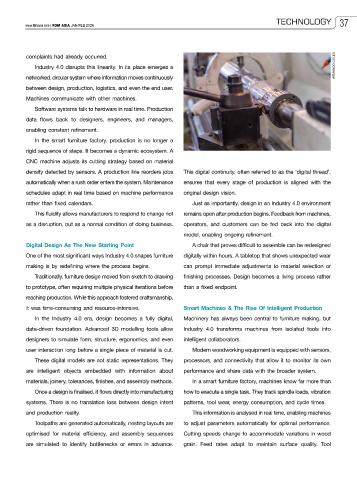
          CNC machine adjusts its cutting strategy based on material
          density detected by sensors. A production line reorders jobs   This digital continuity, often referred to as the ‘digital thread’,
          automatically when a rush order enters the system. Maintenance   ensures that every stage of production is aligned with the
          schedules adapt in real time based on machine performance   original design vision.
          rather than fixed calendars.                          Just as importantly, design in an Industry 4.0 environment

            This fluidity allows manufacturers to respond to change not   remains open after production begins. Feedback from machines,
          as a disruption, but as a normal condition of doing business.  operators,  and  customers  can  be  fed  back  into  the  digital
                                                             model, enabling ongoing refinement.
          Digital Design As The New Starting Point              A chair that proves difficult to assemble can be redesigned
          One of the most significant ways Industry 4.0 shapes furniture   digitally within hours. A tabletop that shows unexpected wear
          making is by redefining where the process begins.   can prompt immediate adjustments to material selection or
            Traditionally, furniture design moved from sketch to drawing   finishing processes. Design becomes a living process rather

          to prototype, often requiring multiple physical iterations before   than a fixed endpoint.
          reaching production. While this approach fostered craftsmanship,
          it was time-consuming and resource-intensive.      Smart Machines & The Rise Of Intelligent Production
            In the Industry 4.0 era, design becomes a fully digital,   Machinery has always been central to furniture making, but
          data-driven foundation. Advanced 3D modelling tools allow   Industry 4.0 transforms machines from isolated tools into
          designers to simulate form, structure, ergonomics, and even   intelligent collaborators.
          user interaction long before a single piece of material is cut.   Modern woodworking equipment is equipped with sensors,
            These digital models are not static representations. They   processors, and connectivity that allow it to monitor its own
          are intelligent objects embedded with information about   performance and share data with the broader system.

          materials, joinery, tolerances, finishes, and assembly methods.  In a smart furniture factory, machines know far more than
            Once a design is finalised, it flows directly into manufacturing   how to execute a single task. They track spindle loads, vibration
          systems. There is no translation loss between design intent   patterns, tool wear, energy consumption, and cycle times.
          and production reality.                               This information is analysed in real time, enabling machines
            Toolpaths are generated automatically, nesting layouts are   to adjust parameters automatically for optimal performance.
          optimised for material efficiency, and assembly sequences   Cutting speeds change to accommodate variations in wood
          are simulated to identify bottlenecks or errors in advance.   grain. Feed rates adapt to maintain surface quality. Tool

