


Page 45 - FDMAsia Mar/Apr 2026
P. 45
MATERIALS         43
         www.fdmasia.com | FDM ASIA MAR/APR 2026


          (AWC TR10), and the Canadian Standard (CSA O86).
            Across all Glulam datasets, charring rate predictions agreed                                      Mateus Andre
          with  tests  within  approximately  ±20  percent,  while  AS/NZS
          1720.4 consistently overpredicted charring and effective char
          depth by around 40 percent.
            In contrast, CLT demonstrates greater variability, primarily

          due to adhesive degradation, delamination, and lamella
          orientation, which influence heat transfer and post-fire capacity.
          CLT data exhibited higher scatter, with effective charring depth
          showing standard deviations of approximately 30–40 percent,
          ZSL  thickness  averaging  about  2.5  times  the  typical  7  mm
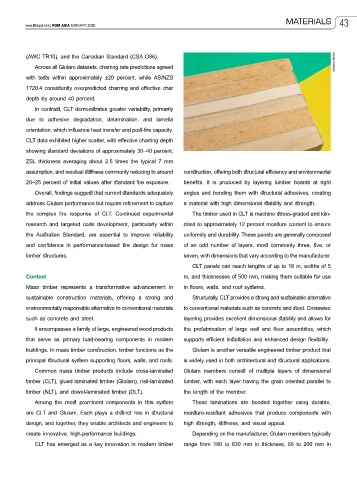
          assumption, and residual stiffness commonly reducing to around   construction, offering both structural efficiency and environmental
          20–25 percent of initial values after standard fire exposure.   benefits.  It  is  produced  by  layering  lumber  boards  at  right
            Overall, findings suggest that current standards adequately   angles and bonding them with structural adhesives, creating
          address Glulam performance but require refinement to capture   a material with high dimensional stability and strength.

          the  complex  fire  response  of  CLT.  Continued  experimental   The timber used in CLT is machine stress-graded and kiln-
          research and targeted code development, particularly within   dried to approximately 12 percent moisture content to ensure
          the  Australian  Standard,  are  essential  to  improve  reliability   uniformity and durability. These panels are generally composed
          and  confidence  in  performance-based  fire  design  for  mass   of  an  odd  number  of  layers,  most  commonly  three,  five,  or
          timber structures.                                 seven, with dimensions that vary according to the manufacturer.
                                                                CLT panels can reach lengths of up to 18 m, widths of 5
          Context                                            m, and thicknesses of 500 mm, making them suitable for use

          Mass timber represents a transformative advancement in   in floors, walls, and roof systems.
          sustainable construction materials, offering a strong and   Structurally, CLT provides a strong and sustainable alternative
          environmentally responsible alternative to conventional materials   to conventional materials such as concrete and steel. Crosswise
          such as concrete and steel.                        layering provides excellent dimensional stability and allows for
            It encompasses a family of large, engineered wood products   the  prefabrication  of  large  wall  and  floor  assemblies,  which
          that  serve  as  primary  load-bearing  components  in  modern   supports efficient installation and enhanced design flexibility.
          buildings. In mass timber construction, timber functions as the   Glulam is another versatile engineered timber product that
          principal structural system supporting floors, walls, and roofs.   is widely used in both architectural and structural applications.
            Common  mass  timber  products  include  cross-laminated   Glulam  members  consist  of  multiple  layers  of  dimensional

          timber (CLT), glued laminated timber (Glulam), nail-laminated   lumber, with each layer having the grain oriented parallel to
          timber (NLT), and dowel-laminated timber (DLT).    the length of the member.
            Among  the  most  prominent  components  in  this  system   These  laminations  are  bonded  together  using  durable,
          are  CLT  and  Glulam.  Each  plays  a  distinct  role  in  structural   moisture-resistant  adhesives  that  produce  components  with
          design, and together, they enable architects and engineers to   high strength, stiffness, and visual appeal.
          create innovative, high-performance buildings.        Depending on the manufacturer, Glulam members typically
            CLT has emerged as a key innovation in modern timber   range  from  180  to  630  mm  in  thickness,  66  to  200  mm  in

