


Page 17 - FDMAsia Sep/Oct 2026
P. 17
FOCUS       15
         www.fdmasia.com | FDM ASIA SEP/OCT 2026


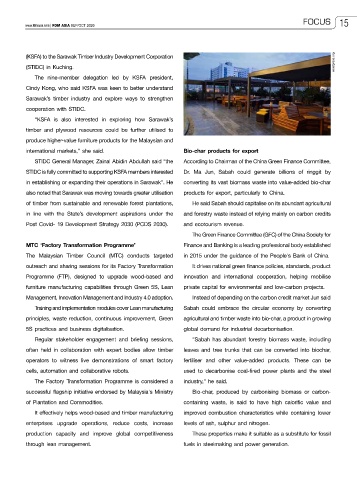
          (KSFA) to the Sarawak Timber Industry Development Corporation
          (STIDC) in Kuching.                                                                                 wordpress.org
            The nine-member delegation led by KSFA president,
          Cindy Kong, who said KSFA was keen to better understand
          Sarawak’s timber industry and explore ways to strengthen
          cooperation with STIDC.

            “KSFA is also interested in exploring how Sarawak’s
          timber and plywood resources could be further utilised to
          produce higher-value furniture products for the Malaysian and
          international markets,” she said.                  Bio-char products for export
            STIDC General Manager, Zainal Abidin Abdullah said “the   According to Chairman of the China Green Finance Committee,
          STIDC is fully committed to supporting KSFA members interested   Dr. Ma Jun,  Sabah could generate billions of ringgit by
          in establishing or expanding their operations in Sarawak”. He   converting its vast biomass waste into value-added bio-char
          also noted that Sarawak was moving towards greater utilisation   products for export, particularly to China.
          of timber from sustainable and renewable forest plantations,   He said Sabah should capitalise on its abundant agricultural

          in line with the State’s development aspirations under the   and forestry waste instead of relying mainly on carbon credits
          Post Covid- 19 Development Strategy 2030 (PCDS 2030).  and ecotourism revenue.
                                                                The Green Finance Committee (GFC) of the China Society for
          MTC ‘Factory Transformation Programme’             Finance and Banking is a leading professional body established
          The Malaysian Timber Council (MTC) conducts targeted   in 2015 under the guidance of the People's Bank of China.
          outreach and sharing sessions for its Factory Transformation   It drives national green finance policies, standards, product
          Programme  (FTP),  designed  to  upgrade  wood-based  and   innovation and international cooperation, helping mobilise

          furniture manufacturing capabilities through Green 5S, Lean   private capital for environmental and low-carbon projects.
          Management, Innovation Management and Industry 4.0 adoption.   Instead of depending on the carbon credit market Jun said
            Training and implementation modules cover Lean manufacturing   Sabah could embrace the circular economy by converting
          principles, waste reduction, continuous improvement, Green   agricultural and timber waste into bio-char, a product in growing
          5S practices and business digitalisation.          global demand for industrial decarbonisation.
            Regular stakeholder engagement and briefing sessions,   “Sabah has abundant forestry biomass waste, including
          often held in collaboration with expert bodies allow timber   leaves and tree trunks that can be converted into biochar,
          operators  to  witness  live  demonstrations  of  smart  factory   fertiliser and other value-added products. These can be
          cells, automation and collaborative robots.        used to decarbonise coal-fired power plants and the steel

            The Factory  Transformation  Programme is considered a   industry,” he said.
          successful flagship initiative endorsed by Malaysia's Ministry   Bio-char, produced by carbonising biomass or carbon-
          of Plantation and Commodities.                     containing  waste,  is  said  to  have  high  calorific  value  and
            It effectively helps wood-based and timber manufacturing   improved combustion characteristics while containing lower
          enterprises upgrade operations, reduce costs, increase   levels of ash, sulphur and nitrogen.
          production capacity and improve global competitiveness   These properties make it suitable as a substitute for fossil
          through lean management.                           fuels in steelmaking and power generation.

