


Page 33 - FDMAsia Sep/Oct 2026
P. 33
TECHNOLOGY           31
         www.fdmasia.com | FDM ASIA SEP/OCT 2026


            Traditional defect inspection in wood primarily relies on
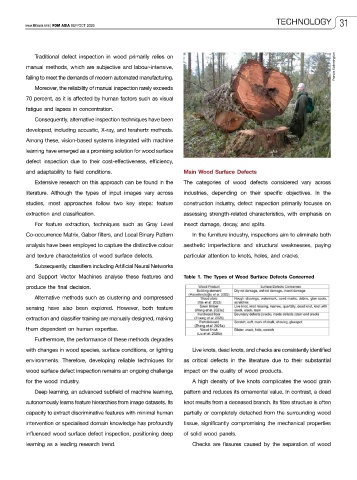
          manual methods, which are subjective and labour-intensive,                                          Francis Eatherington
          failing to meet the demands of modern automated manufacturing.
            Moreover, the reliability of manual inspection rarely exceeds
          70 percent, as it is affected by human factors such as visual
          fatigue and lapses in concentration.

            Consequently, alternative inspection techniques have been
          developed, including acoustic, X-ray, and terahertz methods.
          Among these, vision-based systems integrated with machine
          learning have emerged as a promising solution for wood surface
          defect inspection due  to  their cost-effectiveness, efficiency,
          and adaptability to field conditions.              Main Wood Surface Defects
            Extensive research on this approach can be found in the   The categories of wood defects considered vary across
          literature. Although the types of input images vary across   industries, depending on their specific objectives. In the
          studies, most approaches follow two key steps: feature   construction industry, defect inspection primarily focuses on

          extraction and classification.                     assessing strength-related characteristics, with emphasis on
            For feature extraction, techniques such as Gray Level   insect damage, decay, and splits.
          Co-occurrence Matrix, Gabor filters, and Local Binary Pattern   In the furniture industry, inspections aim to eliminate both
          analysis have been employed to capture the distinctive colour   aesthetic imperfections and structural weaknesses, paying
          and texture characteristics of wood surface defects.   particular attention to knots, holes, and cracks.
            Subsequently, classifiers including Artificial Neural Networks
          and  Support Vector Machines  analyse these  features  and   Table 1. The Types of Wood Surface Defects Concerned

          produce the final decision.
            Alternative methods such as clustering and compressed
          sensing have also been explored. However, both feature
          extraction and classifier training are manually designed, making
          them dependent on human expertise.
            Furthermore, the performance of these methods degrades
          with changes in wood species, surface conditions, or lighting   Live knots, dead knots, and checks are consistently identified
          environments. Therefore, developing reliable techniques for   as critical defects in the literature due to their substantial
          wood surface defect inspection remains an ongoing challenge   impact on the quality of wood products.

          for the wood industry.                                A high density of live knots complicates the wood grain
            Deep learning, an advanced subfield of machine learning,   pattern and reduces its ornamental value. In contrast, a dead
          autonomously learns feature hierarchies from image datasets. Its   knot results from a deceased branch. Its fibre structure is often
          capacity to extract discriminative features with minimal human   partially or completely detached from the surrounding wood
          intervention or specialised domain knowledge has profoundly   tissue, significantly compromising the mechanical properties
          influenced wood surface defect inspection, positioning deep   of solid wood panels.
          learning as a leading research trend.                 Checks are fissures caused by the separation of wood

