


Page 24 - FDMAsia Sep/Oct 2026
P. 24
22    FOCUS                                                                       SEP/OCT 2026 FDM ASIA | www.fdmasia.com


         Tiia Monto                                          INDIA
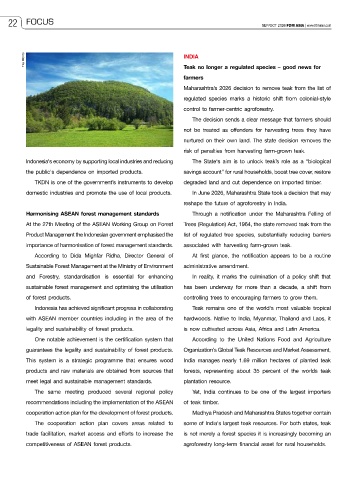
                                                             Teak no longer a regulated species – good news for
                                                             farmers
                                                             Maharashtra’s 2026 decision to remove teak from the list of
                                                             regulated species marks a historic shift from colonial-style
                                                             control to farmer-centric agroforestry.

                                                                The decision sends a clear message that farmers should
                                                             not be treated as offenders for harvesting trees they have
                                                             nurtured on their own land. The state decision removes the
                                                             risk of penalties from harvesting farm-grown teak.
          Indonesia's economy by supporting local industries and reducing   The State‘s aim is to unlock teak’s role as a “biological
          the public's dependence on imported products.      savings account” for rural households, boost tree cover, restore
            TKDN is one of the government’s instruments to develop   degraded land and cut dependence on imported timber.
          domestic industries and promote the use of local products.  In June 2026, Maharashtra State took a decision that may
                                                             reshape the future of agroforestry in India.

          Harmonising ASEAN forest management standards         Through a notification under the Maharashtra Felling of
          At the 27th Meeting of the ASEAN Working Group on Forest   Trees (Regulation) Act, 1964, the state removed teak from the
          Product Management the Indonesian government emphasised the   list of regulated tree species, substantially reducing barriers
          importance of harmonisation of forest management standards.   associated with harvesting farm-grown teak.
            According to Dida Mighfar Ridha, Director General of   At first  glance,  the  notification  appears  to  be  a  routine
          Sustainable Forest Management at the Ministry of Environment   administrative amendment.
          and Forestry, standardisation is essential for enhancing   In reality, it marks the culmination of a policy shift that

          sustainable forest management and optimising the utilisation   has been underway for more than a decade, a shift from
          of forest products.                                controlling trees to encouraging farmers to grow them.
            Indonesia has achieved significant progress in collaborating   Teak remains one of the world‘s most valuable tropical
          with  ASEAN  member  countries including  in  the  area  of  the   hardwoods. Native to India, Myanmar, Thailand and Laos, it
          legality and sustainability of forest products.    is now cultivated across Asia, Africa and Latin America.
            One notable achievement is the certification system that   According to the United Nations Food and Agriculture
          guarantees the legality and sustainability of forest products.   Organization’s Global Teak Resources and Market Assessment,
          This system is  a  strategic programme that  ensures wood   India manages nearly 1.69 million hectares of planted teak
          products and raw materials are obtained from sources that   forests, representing about 35 percent of the worlds teak

          meet legal and sustainable management standards.   plantation resource.
            The same meeting produced several regional policy   Yet, India continues to be one of the largest importers
          recommendations including the implementation of the ASEAN   of teak timber.
          cooperation action plan for the development of forest products.   Madhya Pradesh and Maharashtra States together contain
            The cooperation action plan covers areas related to   some of India‘s largest teak resources. For both states, teak
          trade facilitation, market access and efforts to increase the   is not merely a forest species it is increasingly becoming an
          competitiveness of ASEAN forest products.          agroforestry long-term financial asset for rural households.

