


Page 11 - FDMAsia Mar/Apr 2026
P. 11
MARKET BEATS           9
         www.fdmasia.com | FDM ASIA MAR/APR 2026


            Adding to the pressure are increasingly strict sustainability
          requirements from export markets. South Korea has recently                                          R. Godin - The Wild Center
          tightened its quality standards, driving up export prices.
            Meanwhile, Japan now mandates traceability certifications
          like FSC and PEFC, and is gradually rolling out Sustainable
          Biomass Program (SNP) standards for low-emission supply

          chains.
            To maintain its momentum, the sector must address
          both supply stability and certification compliance. Experts
          urge Vietnamese firms to invest in their own raw material
          zones and prioritise legality and sustainability in line with
          import regulations.
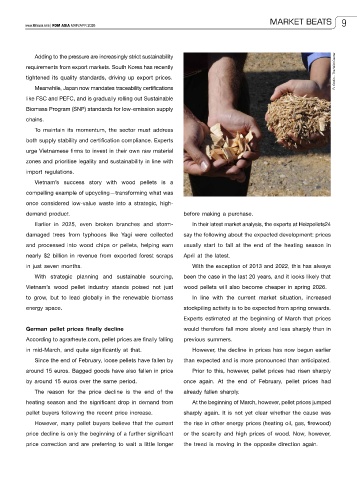
            Vietnam’s success story with wood pellets is a
          compelling example of upcycling—transforming what was
          once considered low-value waste into a strategic, high-

          demand product.                                    before making a purchase.
            Earlier in 2025, even broken branches and storm-    In their latest market analysis, the experts at Heizpellets24
          damaged trees from typhoons like Yagi were collected   say the following about the expected development: prices
          and processed into wood chips or pellets, helping earn   usually start to fall at the end of the heating season in
          nearly  $2  billion  in  revenue from  exported forest scraps   April at the latest.
          in just seven months.                                 With the exception of 2013 and 2022, this has always
            With strategic planning and sustainable sourcing,   been the case in the last 20 years, and it looks likely that

          Vietnam’s wood pellet industry stands poised not just   wood pellets will also become cheaper in spring 2026.
          to grow, but to lead globally in the renewable biomass   In line with the current market situation, increased
          energy space.                                      stockpiling activity is to be expected from spring onwards.
                                                             Experts estimated  at the beginning  of March  that prices
          German pellet prices finally decline               would therefore fall more slowly and less sharply than in
          According to agrarheute.com, pellet prices are finally falling   previous summers.
          in mid-March, and quite significantly at that.        However, the decline in prices has now begun earlier
            Since the end of February, loose pellets have fallen by   than expected and is more pronounced than anticipated.
          around 15 euros. Bagged goods have also fallen in price   Prior to this, however, pellet prices had risen sharply

          by around 15 euros over the same period.           once again. At the end of February, pellet prices had
            The reason for the price decline is the end of the   already fallen sharply.
          heating season and the significant drop in demand from   At the beginning of March, however, pellet prices jumped
          pellet buyers following the recent price increase.  sharply again. It is not yet clear whether the cause was
            However, many pellet buyers believe that the current   the rise in other energy prices (heating oil, gas, firewood)
          price decline is only the beginning of a further significant   or the scarcity and high prices of wood. Now, however,
          price correction and  are preferring to wait a little longer   the trend is moving in the opposite direction again.

