


Page 38 - FDMAsia May/Jun 2026
P. 38
36   TECHNOLOGY                                                                   MAY/JUN 2026 FDM ASIA | www.fdmasia.com


         Getty Images                                        spreadsheets, inventory forecasting depended on historical
                                                                Production schedules were often managed through

                                                             estimates, and quality control relied largely on human
                                                             inspection.
                                                                While these methods worked in slower-moving markets,
                                                             today’s business environment requires far greater speed and

                                                             precision.
                                                                AI changes this dynamic by enabling manufacturers to
                                                             collect, analyse, and respond to data in real time. Machines,
                                                             sensors, production software, and supply chain systems can
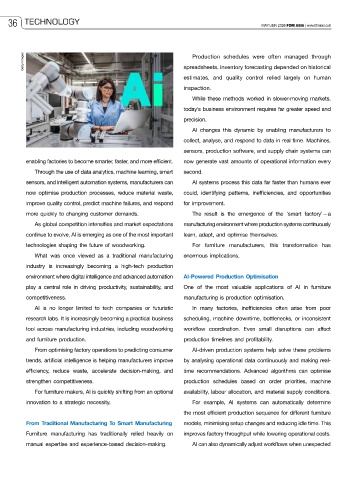
          enabling factories to become smarter, faster, and more efficient.   now generate vast amounts of operational information every
            Through the use of data analytics, machine learning, smart   second.
          sensors, and intelligent automation systems, manufacturers can   AI systems process this data far faster than humans ever
          now optimise production processes, reduce material waste,   could, identifying patterns, inefficiencies, and opportunities
          improve quality control, predict machine failures, and respond   for improvement.

          more quickly to changing customer demands.            The  result is the  emergence  of  the ‘smart  factory’—a
            As global competition intensifies and market expectations   manufacturing environment where production systems continuously
          continue to evolve, AI is emerging as one of the most important   learn, adapt, and optimise themselves.
          technologies shaping the future of woodworking.       For furniture manufacturers, this transformation has
            What was once viewed as a traditional manufacturing   enormous implications.
          industry  is  increasingly  becoming  a  high-tech  production
          environment where digital intelligence and advanced automation   AI-Powered Production Optimisation

          play  a  central  role  in  driving  productivity,  sustainability,  and   One of the most valuable applications of AI in furniture
          competitiveness.                                   manufacturing is production optimisation.
            AI is no longer limited to tech companies or futuristic   In many factories, inefficiencies often arise from poor
          research labs. It is increasingly becoming a practical business   scheduling, machine downtime, bottlenecks, or inconsistent
          tool across manufacturing industries, including woodworking   workflow coordination. Even small disruptions can affect
          and furniture production.                          production timelines and profitability.
            From optimising factory operations to predicting consumer   AI-driven production systems help solve these problems
          trends, artificial intelligence is helping manufacturers improve   by analysing operational data continuously and making real-
          efficiency, reduce waste, accelerate decision-making, and   time recommendations. Advanced algorithms can optimise

          strengthen competitiveness.                        production schedules based on order priorities, machine
            For furniture makers, AI is quickly shifting from an optional   availability, labour allocation, and material supply conditions.
          innovation to a strategic necessity.                  For example, AI systems can automatically determine
                                                             the most efficient production sequence for different furniture
          From Traditional Manufacturing To Smart Manufacturing  models, minimising setup changes and reducing idle time. This
          Furniture manufacturing has traditionally relied heavily on   improves factory throughput while lowering operational costs.
          manual expertise and experience-based decision-making.   AI can also dynamically adjust workflows when unexpected

