Page 51 - FDMASIA JanFeb 2024
P. 51
Materials 49
www.fdmasia.com | FDM AsiA Jan/Feb 2024
Thus, Caryocar villosum, Hymenolobium excelsum, and Additionally, a one percent paraffn emulsion was incorporated
Erisma uncinatum took three, two, and one day, respectively, into the strands. All applications were performed with a
to achieve complete saturation. compressed air gun in a rotary mixer.
Before generating the wood strands, the blocks were The orientation of the inner layer of the panels was placed
soaked in hot water at 90 °C for eight hours using a heating perpendicular to the outer faces in a 30:40:30 ratio. The mats
tank. Subsequently, strands with dimensions of 0.65 × 25 × were pre-pressed using a target pressure of 1.6 kgf/square
90 mm (t × w × l) were produced. The Pinus caribaea wood cm for a duration of 10 min, using a manual hydraulic press.
did not require autoclaving or preheating since it was naturally Subsequently, they were subjected to a secondary press
saturated and easy to cut. process using a motorized hydraulic press, applying 35 kgf/
Afterward, the strands were dried in an oven with forced square cm of pressure at a temperature of 180 deg C for
air circulation at 80 deg C until the strands reached a fnal 10 min.
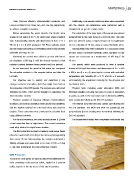
moisture content between three percent and four percent. The panels, which were produced to have a nominal
As we immersed the wood in hot water, we compared density of 650 kg/cubic metres and dimensions of 15.7 × 560
the extractive contents in the samples before and after the × 560 x mm (t × w × l), were kept in a room with controlled
hot bath. temperature and humidity (22 ± 2 °C and 65 ± 5 percent)
Our objective was to identify and determine if any until reaching the equilibrium humidity for the physical and
changes occurred and what effect they might have had on mechanical tests.
the properties of the OSB panels. The analysis was performed Physical tests, including water absorption (WA) and
following the NBR 14853 (2010) standard to determine the thickness swelling (TS) after two and 24 hours of immersion
total extractive content. in water, as well as the non-return rate in thickness (NRRT),
Random samples of Caryocar villosum, Hymenolobium were conducted following the EN 317 standard.
excelsum, and Erisma uncinatum were ground and classifed, The internal bond test (IB) was carried out following the
and the fraction retained on a 40-mesh sieve was used for EN 319 standard. The MOR and MOE for parallel (//) and
analysis. Three extractions were conducted in a Soxhlet fask perpendicular () static bending were determined following the
using different solvents. EN 310 standard.
For the frst extraction, we used alcohol:toluene (1:2) with The experimental design was completely randomized and
a total extraction time of eight hours. The second extraction
used ethyl alcohol for eight hours duration. Kmpzzz
The third extraction involved hot water in Erlenmeyer fasks
placed in a water bath at 95 deg C for one hour, homogenizing
them every 15 min. Subsequently, the samples underwent a
fltering process and were dried in an oven at 103 ± 2 deg
C. We then determined the total extractive content.
OSB Production
To bond the OSB panel, we used a phenol–formaldehyde (PF)
resin containing 53.09 percent solids, applied at 6 percent
solids, based on the dry mass of the strand particles.