


Page 27 - FDMAsia Mar/Apr 2026
P. 27
TECHNOLOGY           25
         www.fdmasia.com | FDM ASIA MAR/APR 2026


          principles of open innovation, as such transitions cannot be
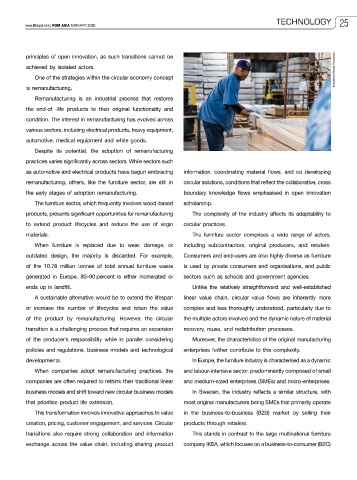
          achieved by isolated actors.                                                                        Industrial Wood Products
            One of the strategies within the circular economy concept
          is remanufacturing.
            Remanufacturing  is  an  industrial  process  that restores
          the end-of -life products to their original functionality and

          condition. The interest in remanufacturing has evolved across
          various sectors, including electrical products, heavy equipment,
          automotive, medical equipment and white goods.
            Despite its potential, the adoption of remanufacturing
          practices varies significantly across sectors. While sectors such
          as automotive and electrical products have begun embracing   information, coordinating material flows, and co developing
          remanufacturing, others, like the furniture sector, are still in   circular solutions, conditions that reflect the collaborative, cross
          the early stages of adoption remanufacturing.      boundary knowledge flows emphasised in open innovation
            The furniture sector, which frequently involves wood-based   scholarship.

          products, presents significant opportunities for remanufacturing   The complexity of the industry affects its adaptability to
          to extend product lifecycles and reduce the use of virgin   circular practices.
          materials.                                            The furniture sector comprises a wide range of actors,
            When furniture is replaced due to wear, damage, or   including subcontractors, original producers, and retailers.
          outdated design, the majority is discarded. For example,   Consumers and end-users are also highly diverse as furniture
          of the 10.78 million tonnes of total annual furniture waste   is used by private consumers and organisations, and public
          generated in Europe, 80–90 percent is either incinerated or   sectors such as schools and government agencies.

          ends up in landfill.                                  Unlike the relatively straightforward and well-established
            A sustainable alternative would be to extend the lifespan   linear value chain, circular value flows are inherently more
          or increase the number of lifecycles and retain the value   complex and less thoroughly understood, particularly due to
          of  the  product  by  remanufacturing.  However, the  circular   the multiple actors involved and the dynamic nature of material
          transition is a challenging process that requires an expansion   recovery, reuse, and redistribution processes.
          of the producer’s responsibility while in parallel considering   Moreover, the characteristics of the original manufacturing
          policies and regulations, business models and technological   enterprises further contribute to this complexity.
          developments.                                         In Europe, the furniture industry is characterised as a dynamic
            When  companies  adopt  remanufacturing  practices,  the   and labour-intensive sector, predominantly composed of small

          companies are often required to rethink their traditional linear   and medium-sized enterprises (SMEs) and micro-enterprises.
          business models and shift toward new circular business models   In Sweden, the industry reflects a similar structure, with
          that prioritise product life extension.            most original manufacturers being SMEs that primarily operate
            This transformation involves innovative approaches to value   in the business-to-business (B2B) market by selling their
          creation, pricing, customer engagement, and services. Circular   products through retailers.
          transitions also require strong collaboration and information   This stands in contrast to the large multinational furniture
          exchange  across  the  value  chain,  including  sharing  product   company IKEA, which focuses on a business-to-consumer (B2C)

