


Page 32 - FDMAsia Mar/Apr 2026
P. 32
30   DESIGN                                                                       MAR/APR 2026 FDM ASIA | www.fdmasia.com


          INTERNATIONAL JOURNAL OF ARTS


          ARCHITECTURE & DESIGN FROM


          CRAFTSMANSHIP TO CONVENIENCE: A


          SHIFT FROM HANDMADE TO MODULAR


          FURNITURE IN THE RESIDENTIAL SECTOR


          The Indian residential furniture sector is undergoing a transformative shift from traditional handmade
          furniture to modular systems, driven by rapid urbanisation, evolving consumer preferences, and
          technological advancements in design and production. This study investigates the extent and impact
          of this transition in Pune, a Tier-2 city that has both traditional and contemporary lifestyles. By
          Prachi Pande and Shiva Shishodia, S. B. Patil College of Architecture & Design


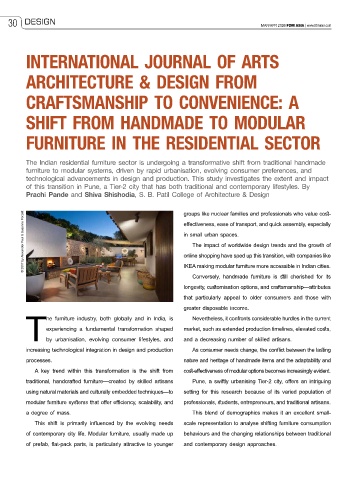
                                                             groups like nuclear families and professionals who value cost-
         © 2017 by Alexander Paul & Susanne Porzelt          effectiveness, ease of transport, and quick assembly, especially

                                                             in small urban spaces.
                                                                The impact of worldwide design trends and the growth of
                                                             online shopping have sped up this transition, with companies like
                                                             IKEA making modular furniture more accessible in Indian cities.
                                                                Conversely,  handmade  furniture  is  still  cherished  for  its

                                                             longevity, customisation options, and craftsmanship—attributes
                                                             that  particularly  appeal  to  older  consumers  and  those  with
                                                             greater disposable income.
                he furniture industry, both globally and in India, is   Nevertheless, it confronts considerable hurdles in the current
                experiencing a fundamental transformation shaped   market, such as extended production timelines, elevated costs,
          Tby urbanisation, evolving consumer lifestyles, and   and a decreasing number of skilled artisans.
          increasing technological integration in design and production   As consumer needs change, the conflict between the lasting
          processes.                                         nature and heritage of handmade items and the adaptability and
            A  key trend within this transformation  is the  shift  from   cost-effectiveness of modular options becomes increasingly evident.

          traditional,  handcrafted  furniture—created  by  skilled  artisans   Pune,  a  swiftly  urbanising  Tier-2  city,  offers  an  intriguing
          using natural materials and culturally embedded techniques—to   setting for this research because of its varied population of
          modular furniture systems that offer efficiency, scalability, and   professionals, students, entrepreneurs, and traditional artisans.
          a degree of mass.                                     This blend of demographics makes it an excellent small-
            This  shift  is  primarily  influenced  by  the  evolving  needs   scale representation to analyse shifting furniture consumption
          of contemporary city life. Modular furniture, usually made up   behaviours and the changing relationships between traditional
          of prefab, flat-pack parts, is particularly attractive to younger   and contemporary design approaches.

