


Page 51 - FDMAsia Mar/Apr 2026
P. 51
MATERIALS         49
         www.fdmasia.com | FDM ASIA MAR/APR 2026


          lower than tests. Eurocode 5, Swedish, AWC TR10, and CSA   current charring models remain slightly conservative, residual
          O86  maintained  mean  values  close  to  unity,  demonstrating   strength  predictions  may  be  non-conservative  for  extended
          reliable and balanced performance.                 exposure durations.
            For  CLT  elements,  residual  strengths  showed  extensive   In contrast, CLT demonstrated a more complex and less
          scatter ranging from 10 percent to 70 percent depending on   predictable thermal response, as evidenced by the increased
          lamella  configuration,  adhesive  performance,  and  degree  of   scatter and bias observed across experimental datasets.

          delamination. Swedish, AWC TR10, and CSA O86 standards   Cross-lamination, adhesive softening, and inter-layer interfaces
          all  overestimated  the  mean  residual  strength,  with  mean   promoted  delamination,  intermittently  exposing  previously
          normalised values ranging from 1.36 to 1.61.       uncharred layers to renewed heating and accelerating effective
            The  corresponding  standard  deviation  approached  100   charring beyond code-based assumptions.
          percent for all standards, highlighting the substantial variability   The  adhesive-dependent  behaviour  provides  a  critical
          of predictions compared with Glulam outcomes.      explanation for the observed divergence between experimental
            Residual  stiffness  predictions  for  Glulam  beams  showed   results and code predictions. CLT panels bonded with thermosetting
          considerable scatter when compared with experimental data,   adhesives generally exhibited limited delamination and more
          indicating inconsistency in predicting post-fire stiffness retention.   stable  char  development,  while  panels  manufactured  with

            AS/NZS 1720.4 consistently underpredicted residual stiffness,   heat-softening adhesives experienced earlier bond degradation,
          while Eurocode 5, Swedish, AWC TR10, and CSA O86 tended   increased delamination frequency, and accelerated charring.
          to overestimate stiffness recovery.                   When comparing international standards, Eurocode 5 and
            Standard deviations across all codes ranged between 40   CSA  O86  provided  the  closest  agreement  with  experimental
          percent and 90 percent, indicating that residual stiffness was   charring rates for Glulam, whereas AWC TR10 and AS/NZS
          more sensitive to localised charring, adhesive degradation, and   1720.4 were consistently more conservative.
          moisture-induced softening than residual strength.    For CLT, however, none of the evaluated standards adequately

            For CLT elements, residual stiffness ranged from 10 percent   captured the magnitude or variability of the observed charring
          to  50  percent  of  initial  stiffness,  with  greater  scatter  than   behaviour, reinforcing the need for time-dependent, adhesive-
          Glulam due to composite layer configuration and interlaminar   sensitive, or interface-aware correction factors.
          adhesive behaviour.
            All standards overestimated stiffness retention, with mean
          normalised  values  ranging  from  1.46  to  1.65.  The  standard                                   Nicolerose25
          deviation exceeded 200 percent across all standards, highlighting
          extreme variability and poor correlation with test data.
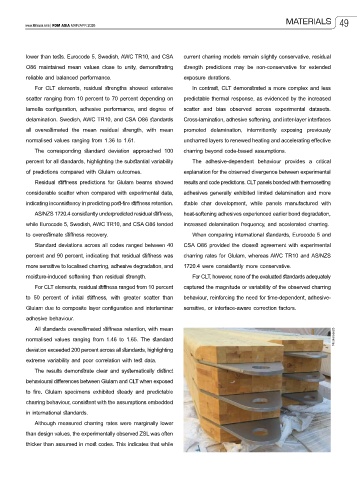
            The  results  demonstrate  clear  and  systematically  distinct

          behavioural differences between Glulam and CLT when exposed
          to  fire.  Glulam  specimens  exhibited  steady  and  predictable
          charring behaviour, consistent with the assumptions embedded
          in international standards.
            Although measured charring rates were marginally lower
          than design values, the experimentally observed ZSL was often
          thicker than assumed in most codes. This indicates that while

