


Page 55 - FDMAsia Mar/Apr 2026
P. 55
MATERIALS         53
         www.fdmasia.com | FDM ASIA MAR/APR 2026


            The dimensional distribution of the furnish particles showed   Distance bars were used during hot-pressing for consistent
          that  LS-/  contained  19.4  percent  particles  <0.5  mm,  20.7   board thickness.
          percent  particles  0.5–1  mm,  43.5  percent  particles  1–2  mm,
          and 16.2 percent particles >2 mm. LS-I contained 35.3 percent   Evaluation
          particles  <0.5  mm,  17.6  percent  particles  0.5–1  mm,  14.6   The obtained particleboards were characterised according
          percent particles 1–2 mm, and 32.4 percent particles >2 mm.   to relevant standards by determining the density, modulus

            RE contained 12.8 percent particles <0.5 mm, 27.6 percent   of elasticity (MOE) and modulus of rupture (MOR) in a three-
          particles 0.5–1 mm, 26.2 percent particles 1–2 mm, and 33.4   point bending test, tensile strength perpendicular to the board
          percent particles >2 mm.                           surface (IB), thickness swelling (TS) and water absorption
            Ethanol-extracted birch outer bark was ground to pass a   (WA) after 24 hours immersion in water, and face withdrawal
          2  mm  sieve  and  hydrolytically  depolymerised  in  a  4  percent   of screw resistance (WSR).
          KOH solution for 30 minutes.                          In addition, surface optical morphology was performed with
            The  filtered  wet  product  with  a  moisture  content  of   stereoscopic light microscopy equipped with image acquisition
          approximately 75 percent was used as the SA-based binder   software, analysing face and cross sections of the boards at
          (solubility  in  tetrahydrofuran  ~54  percent,  monosaccharides   2× magnification.

          11.4 percent, ω-hydroxy acids 17.1 percent, α,ω-diacids ~20.8   Five specimens were tested for each property to calculate
          percent, triterpenes 11.0 percent, acid number ~49 mg KOH/g)   the average value for each particleboard type.
          without any additional additives.                     The resulting board properties were compared with the
            Three-layer particleboards were produced using the three   European requirements specified in EN 312 for particleboards
          furnishes described above. To utilise all fractions of sawn LS   intended for interior fitments (including furniture) for use in dry
          particles, the face layers were formed from particles with a   conditions (Type P2). The influence of selected factors on the
          fraction  <1  mm,  while  the  core  layer  consisted  of  particles   mean property values was analysed at a confidence level α =

          >1 mm.                                             0.05 using one-way ANOVA and correlation tools.
            Based on a previous study, 21–25 wt. percent (dry basis)
          of wet SA binder was added to the LS furnishes, and 15–21   Properties Of Obtained Particleboards
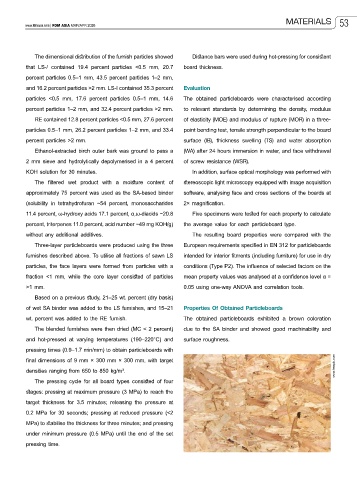
          wt. percent was added to the RE furnish.           The obtained particleboards exhibited a brown coloration
            The blended furnishes were then dried (MC < 2 percent)   due to the SA binder and showed good machinability and
          and  hot-pressed  at  varying  temperatures  (190–220°C)  and   surface roughness.
          pressing times (0.9–1.7 min/mm) to obtain particleboards with
          final dimensions of 9 mm × 300 mm × 300 mm, with target
          densities ranging from 650 to 850 kg/m³.                                                            www.freepik.com

            The  pressing  cycle  for  all  board  types  consisted  of  four
          stages: pressing at maximum pressure (3 MPa) to reach the
          target  thickness  for  3.5  minutes;  releasing  the  pressure  at
          0.2  MPa  for  30  seconds;  pressing  at  reduced  pressure  (<2
          MPa) to stabilise the thickness for three minutes; and pressing
          under  minimum  pressure  (0.5  MPa)  until  the  end  of  the  set
          pressing time.

