


Page 53 - FDMAsia Mar/Apr 2026
P. 53
MATERIALS         51
         www.fdmasia.com | FDM ASIA MAR/APR 2026


          DEVELOPMENT OF ECO-FRIENDLY


          PARTICLEBOARDS FROM SAWDUST AND


          RECYCLED WOOD


          The conventional particleboard industry poses environmental, health, and end-use risks. Besides,
          rising raw material prices, regulatory restrictions, and increasing competition in the wood-processing
          sector have further highlighted the importance of alternative biomass resources for particleboard
          production. In response to these challenges, this study investigates the suitability of available
          sawdust resources derived from the production residues of cellular wood materials and recycled
          particleboards, combined with natural suberinic acids mixture obtained from birch outer bark as a
          binder. By Ramunas Tupciauskas, Andris Berzins, Gunars Pavlovics, Rudolfs Berzins, Martins
          Andzs and Janis Rizikovs, Latvian State Institute of Wood Chemistry

                he  conventional  global  production  of wood-based
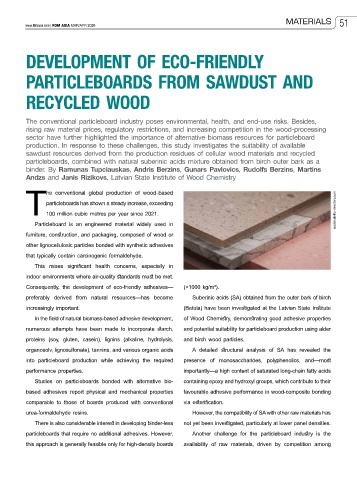
                particleboards has shown a steady increase, exceeding

          T100 million cubic metres per year since 2021.                                                      sustainability-directory.com
            Particleboard is an engineered material widely used in
          furniture, construction, and packaging, composed of wood or
          other lignocellulosic particles bonded with synthetic adhesives
          that typically contain carcinogenic formaldehyde.
            This  raises  significant  health  concerns,  especially  in
          indoor environments where air-quality standards must be met.

          Consequently,  the  development  of  eco-friendly  adhesives—  (>1000 kg/m³).
          preferably derived from natural resources—has become   Suberinic acids (SA) obtained from the outer bark of birch
          increasingly important.                            (Betula) have been investigated at the Latvian State Institute
            In the field of natural biomass-based adhesive development,   of Wood Chemistry, demonstrating good adhesive properties
          numerous  attempts  have  been  made  to  incorporate  starch,   and potential suitability for particleboard production using alder
          proteins  (soy,  gluten,  casein),  lignins  (alkaline,  hydrolysis,   and birch wood particles.
          organosolv, lignosulfonate), tannins, and various organic acids   A  detailed  structural  analysis  of  SA  has  revealed  the
          into particleboard production while achieving the required   presence  of  monosaccharides,  polyphenolics,  and—most
          performance properties.                            importantly—a high content of saturated long-chain fatty acids

            Studies  on  particleboards  bonded  with  alternative  bio-  containing epoxy and hydroxyl groups, which contribute to their
          based  adhesives  report  physical  and  mechanical  properties   favourable adhesive performance in wood-composite bonding
          comparable  to  those  of  boards  produced  with  conventional   via esterification.
          urea-formaldehyde resins.                             However, the compatibility of SA with other raw materials has
            There is also considerable interest in developing binder-less   not yet been investigated, particularly at lower panel densities.
          particleboards that require no additional adhesives. However,   Another  challenge  for  the  particleboard  industry  is  the
          this approach is generally feasible only for high-density boards   availability of raw materials, driven by competition among

