


Page 58 - FDMAsia Mar/Apr 2026
P. 58
56   MATERIALS                                                                    MAR/APR 2026 FDM ASIA | www.fdmasia.com


         GennadiyUdovichenko                                 with  almost  all  board  properties  except  IB,  indicating  that  a
                                                             higher binder content improved IB, WA, and TS. Pressing rate
                                                             showed  the  weakest  overall  effect  on  the  board  properties,
                                                             with a moderately negative correlation observed only for MOE.
                                                                Overall,  these  conclusions  are  consistent  with  previous
                                                             studies  on  particleboard  production,  including  boards  made

                                                             from flax shives and sunflower bark bonded by casein-based
                                                             adhesives, sawmill residues bonded with formaldehyde-based
                                                             MUF adhesive, miscanthus bonded with synthetic MDI, and
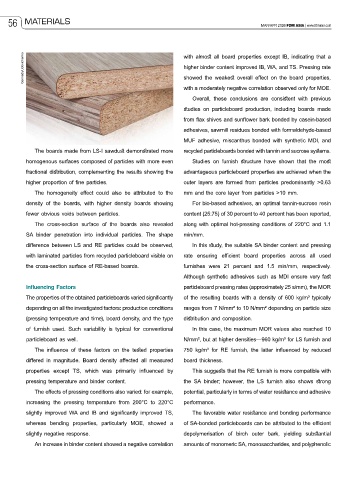
            The boards made from LS-I sawdust demonstrated more   recycled particleboards bonded with tannin and sucrose systems.
          homogenous surfaces composed of particles with more even   Studies  on  furnish  structure  have  shown  that  the  most
          fractional distribution, complementing the results showing the   advantageous particleboard properties are achieved when the
          higher proportion of fine particles.               outer  layers  are  formed  from  particles  predominantly  >0.63
            The  homogeneity  effect  could  also  be  attributed  to  the   mm and the core layer from particles >10 mm.
          density of the boards, with higher density boards showing   For bio-based adhesives, an optimal tannin-sucrose resin

          fewer obvious voids between particles.             content (25:75) of 30 percent to 40 percent has been reported,
            The  cross-section  surface  of  the  boards  also  revealed   along  with  optimal  hot-pressing  conditions  of  220°C  and  1.1
          SA binder penetration into individual particles.  The shape   min/mm.
          difference  between  LS  and  RE  particles  could  be  observed,   In this study, the suitable SA binder content and pressing
          with laminated particles from recycled particleboard visible on   rate  ensuring  efficient  board  properties  across  all  used
          the cross-section surface of RE-based boards.      furnishes  were  21  percent  and  1.5  min/mm,  respectively.
                                                             Although  synthetic  adhesives  such  as  MDI  ensure  very  fast

          Influencing Factors                                particleboard pressing rates (approximately 25 s/mm), the MOR
          The properties of the obtained particleboards varied significantly   of  the  resulting  boards  with  a  density  of  600  kg/m³  typically
          depending on all the investigated factors: production conditions   ranges from 7 N/mm² to 10 N/mm² depending on particle size
          (pressing temperature and time), board density, and the type   distribution and composition.
          of furnish used. Such variability is typical for conventional   In this case, the maximum MOR values also reached 10
          particleboard as well.                             N/mm², but at higher densities—960 kg/m³ for LS furnish and
            The  influence  of  these  factors  on  the  tested  properties   750  kg/m³  for  RE  furnish,  the  latter  influenced  by  reduced
          differed  in  magnitude.  Board  density  affected  all  measured   board thickness.
          properties  except  TS,  which  was  primarily  influenced  by   This suggests that the RE furnish is more compatible with

          pressing temperature and binder content.           the  SA  binder;  however,  the  LS  furnish  also  shows  strong
            The effects of pressing conditions also varied: for example,   potential, particularly in terms of water resistance and adhesive
          increasing  the  pressing  temperature  from  200°C  to  220°C   performance.
          slightly  improved  WA  and  IB  and  significantly  improved  TS,                                   The favorable water resistance and bonding performance
          whereas bending  properties,  particularly MOE, showed a   of SA-bonded particleboards can be attributed to the efficient
          slightly negative response.                        depolymerisation  of  birch  outer  bark,  yielding  substantial
            An increase in binder content showed a negative correlation   amounts of monomeric SA, monosaccharides, and polyphenolic

