


Page 17 - FDMAsia May/Jun 2026
P. 17
FEATURES        15
         www.fdmasia.com | FDM ASIA MAY/JUN 2026


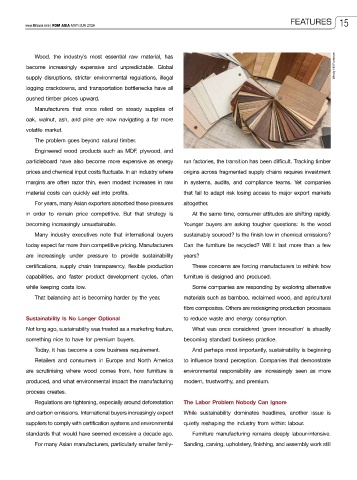
            Wood, the industry’s most essential raw material, has
          become increasingly expensive and unpredictable. Global                                             Windy Hill Furniture
          supply disruptions, stricter environmental regulations, illegal
          logging crackdowns, and transportation bottlenecks have all
          pushed timber prices upward.
            Manufacturers that once relied on steady supplies of

          oak, walnut, ash, and pine are now navigating a far more
          volatile market.
            The problem goes beyond natural timber.
            Engineered wood products such as MDF, plywood, and
          particleboard  have  also  become  more  expensive  as  energy   run factories, the transition has been difficult. Tracking timber
          prices and chemical input costs fluctuate. In an industry where   origins across fragmented supply chains requires investment
          margins are often razor thin, even modest increases in raw   in systems, audits, and compliance teams. Yet companies
          material costs can quickly eat into profits.       that fail to adapt risk losing access to major export markets
            For years, many Asian exporters absorbed these pressures   altogether.

          in order to remain price competitive. But that strategy is   At the same time, consumer attitudes are shifting rapidly.
          becoming increasingly unsustainable.               Younger  buyers are  asking tougher  questions:  Is  the  wood
            Many industry executives note that international buyers   sustainably sourced? Is the finish low in chemical emissions?
          today expect far more than competitive pricing. Manufacturers   Can the furniture be recycled? Will it last more than a few
          are increasingly under pressure to provide sustainability   years?
          certifications, supply chain transparency, flexible production   These concerns are forcing manufacturers to rethink how
          capabilities,  and faster  product development  cycles,  often   furniture is designed and produced.

          while keeping costs low.                              Some companies are responding by exploring alternative
            That balancing act is becoming harder by the year.  materials such as bamboo, reclaimed wood, and agricultural
                                                             fibre composites. Others are redesigning production processes
          Sustainability Is No Longer Optional               to reduce waste and energy consumption.
          Not long ago, sustainability was treated as a marketing feature,   What was once considered ‘green innovation’ is steadily
          something nice to have for premium buyers.         becoming standard business practice.
            Today, it has become a core business requirement.   And perhaps most importantly, sustainability is beginning
            Retailers and consumers in Europe and North America   to influence brand perception. Companies that demonstrate
          are scrutinising where wood comes from, how furniture is   environmental responsibility are increasingly seen as more

          produced, and what environmental impact the manufacturing   modern, trustworthy, and premium.
          process creates.
            Regulations are tightening, especially around deforestation   The Labor Problem Nobody Can Ignore
          and carbon emissions. International buyers increasingly expect   While sustainability dominates headlines, another issue is
          suppliers to comply with certification systems and environmental   quietly reshaping the industry from within: labour.
          standards that would have seemed excessive a decade ago.  Furniture manufacturing remains deeply labour-intensive.
            For many Asian manufacturers, particularly smaller family-  Sanding, carving, upholstery, finishing, and assembly work still

