


Page 45 - FDMAsia May/Jun 2026
P. 45
MATERIALS         43
         www.fdmasia.com | FDM ASIA MAY/JUN 2026


          overall durability performance of wood based panels.  In  this  context,  this  study  investigates  the  dimensional
            Natural weathering provides the most realistic assessment   stability and mechanical performance of three industrial panels
          of  durability  by  exposing  panels  to  environmental  stresses,   designed for outdoor use by measuring changes in MOR,
          including precipitation, temperature changes, ultraviolet radiation,   MOE, and IB strength under accelerated aging conditions.
          freeze thaw cycles, and biological attack.            This  work  makes  a  novel  contribution  by  comparing
            Outdoor  tests  provide  valuable  data  on  real  world   commercially available exterior grade particleboard and MDF

          performance, forming the basis for service life estimates and   products  under  standardised  aging  conditions. Additionally,  it
          lab correlations. However, natural weathering has limitations: it   examines how specimen orientation (parallel vs. perpendicular
          takes at least five years to obtain reliable data, regional climate   to  mat  formation)  affects  both  dimensional  stability  and
          variability complicates standardisation, weather conditions are   mechanical performance.
          unpredictable, and outdoor testing is resource intensive.
            These issues have led to the development of accelerated   Materials
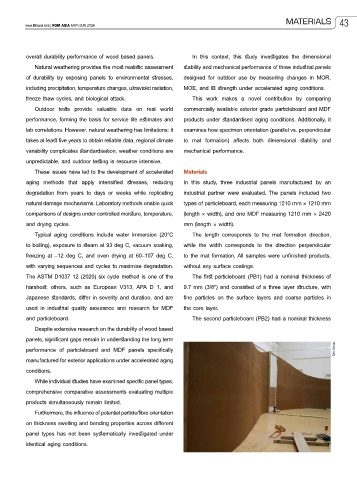
          aging  methods  that  apply  intensified  stresses,  reducing   In this study, three industrial panels manufactured by an
          degradation  from  years  to  days  or  weeks  while  replicating   industrial partner were evaluated. The panels included two
          natural damage mechanisms. Laboratory methods enable quick   types of particleboard, each measuring 1210 mm × 1210 mm

          comparisons of designs under controlled moisture, temperature,   (length × width), and one MDF measuring 1210 mm × 2420
          and drying cycles.                                 mm (length × width).
            Typical  aging  conditions  include  water  immersion  (20°C   The  length  corresponds  to  the  mat  formation  direction,
          to boiling), exposure to steam at 93 deg C, vacuum soaking,   while the width corresponds to the direction perpendicular
          freezing  at  –12  deg  C,  and  oven  drying  at  60–107  deg  C,   to  the  mat  formation. All  samples  were  unfinished  products,
          with varying sequences and cycles to maximise degradation.   without any surface coatings.
          The ASTM D1037 12 (2020) six cycle method is one of the   The  first  particleboard  (PB1)  had  a  nominal  thickness  of

          harshest;  others,  such  as  European  V313,  APA  D  1,  and   9.7  mm  (3/8″)  and  consisted  of  a  three  layer  structure,  with
          Japanese  standards,  differ  in  severity  and  duration,  and  are   fine  particles  on  the  surface  layers  and  coarse  particles  in
          used  in  industrial  quality  assurance  and  research  for  MDF   the core layer.
          and particleboard.                                    The second particleboard (PB2) had a nominal thickness
            Despite extensive research on the durability of wood based
          panels, significant gaps remain in understanding the long term
                                                                                                              Dirk Stoop
          performance  of  particleboard  and  MDF  panels  specifically
          manufactured for exterior applications under accelerated aging
          conditions.

            While individual studies have examined specific panel types,
          comprehensive comparative assessments evaluating multiple
          products simultaneously remain limited.
            Furthermore, the influence of potential particle/fibre orientation
          on thickness swelling and bending properties across different
          panel  types  has  not  been  systematically  investigated  under
          identical aging conditions.

