


Page 50 - FDMAsia May/Jun 2026
P. 50
48   MATERIALS                                                                    MAY/JUN 2026 FDM ASIA | www.fdmasia.com


         Magnific                                               PB2 demonstrated superior overall performance, combining
                                                             exceptional  dimensional  stability  (Residual  TS:  0.49%)  with
                                                             strong retention of mechanical properties (MOR: 67%, MOE:
                                                             56–64%, IB: 75%).
                                                                Its  homogeneous  fine  particle  structure  and  lower  core
                                                             density contributed to reduced internal stresses and improved

                                                             water resistance. For demanding outdoor environments requiring
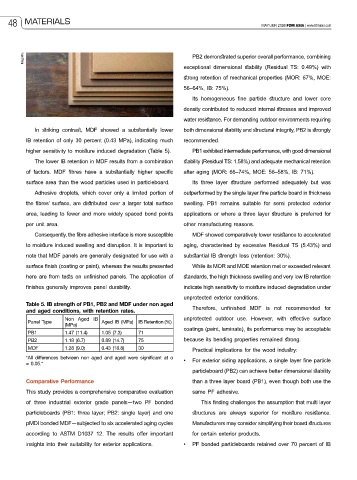
            In  striking  contrast,  MDF  showed  a  substantially  lower   both dimensional stability and structural integrity, PB2 is strongly
          IB  retention  of  only  30  percent  (0.43  MPa),  indicating  much   recommended.
          higher sensitivity to moisture induced degradation (Table 5).  PB1 exhibited intermediate performance, with good dimensional
            The lower IB retention in MDF results from a combination   stability (Residual TS: 1.58%) and adequate mechanical retention
          of  factors.  MDF  fibres  have  a  substantially  higher  specific   after aging (MOR: 66–74%, MOE: 56–58%, IB: 71%).
          surface area than the wood particles used in particleboard.   Its  three  layer  structure  performed  adequately  but  was
            Adhesive  droplets,  which  cover  only  a  limited  portion  of   outperformed by the single layer fine particle board in thickness
          the fibres’ surface, are distributed over a larger total surface   swelling.  PB1  remains  suitable  for  semi  protected  exterior

          area,  leading  to  fewer  and  more  widely  spaced  bond  points   applications  or  where  a  three  layer  structure  is  preferred  for
          per unit area.                                     other manufacturing reasons.
            Consequently, the fibre adhesive interface is more susceptible   MDF showed comparatively lower resistance to accelerated
          to moisture induced swelling and disruption. It is important to   aging,  characterised  by  excessive  Residual TS  (5.43%)  and
          note that MDF panels are generally designated for use with a   substantial IB strength loss (retention: 30%).
          surface finish (coating or paint), whereas the results presented   While its MOR and MOE retention met or exceeded relevant
          here are from tests on unfinished panels. The application of   standards, the high thickness swelling and very low IB retention

          finishes generally improves panel durability.      indicate high sensitivity to moisture induced degradation under
                                                             unprotected exterior conditions.
          Table 5. IB strength of PB1, PB2 and MDF under non aged
          and aged conditions, with retention rates.            Therefore,  unfinished  MDF  is  not  recommended  for
                      Non Aged IB                            unprotected  outdoor  use.  However,  with  effective  surface
          Panel Type              Aged IB (MPa)  IB Retention (%)
                      (MPa)                                  coatings (paint, laminate), its performance may be acceptable
          PB1         1.47 (11.4)  1.05 (7.3)  71
          PB2         1.18 (6.7)  0.89 (14.7)  75            because its bending properties remained strong.
          MDF         1.28 (9.0)  0.43 (18.8)  30               Practical implications for the wood industry:
         *All differences between non aged and aged were significant at  α   •  For exterior siding applications, a single layer fine particle
         = 0.05.*
                                                                particleboard (PB2) can achieve better dimensional stability

          Comparative Performance                               than a three layer board (PB1), even though both use the
          This study provides a comprehensive comparative evaluation   same PF adhesive.
          of  three  industrial  exterior  grade  panels—two  PF  bonded   This finding challenges the assumption that multi layer
          particleboards (PB1: three layer; PB2: single layer) and one   structures  are  always  superior  for  moisture  resistance.
          pMDI bonded MDF—subjected to six accelerated aging cycles   Manufacturers may consider simplifying their board structures
          according  to ASTM D1037 12. The results offer important   for certain exterior products.
          insights into their suitability for exterior applications.  •  PF bonded particleboards retained over 70 percent of IB

