


Page 48 - FDMAsia May/Jun 2026
P. 48
46   MATERIALS                                                                    MAY/JUN 2026 FDM ASIA | www.fdmasia.com


          before IB testing.                                 Table 2. VDP variables and EMC of exterior grade
                                                             particleboards (PB1, PB2) and MDF under non aged
            All  mechanical  property  tests  were  conducted  using  a   and aged conditions.
          universal  testing  machine  with  a  load  capacity  of  5  kN. The   Panel  Average   Max   Min Core   Non Aged  Aged
                                                             Type  Density   Surface   Density   EMC (%)  EMC (%)
          strength  retention  rates  were  calculated  as  (average  aged   (kg/m³)  Density   (kg/m³)
                                                                           (kg/m³)
          property value / average non aged property value) × 100 percent.
                                                             PB1   780 (4.3)  898 (6.7)  737 (4.9)  10.2 (1.3)  9.7 (1.6)
            Statistical analyses were performed using R software. For   PB2  735 (6.2)  959 (5.3)  654 (6.8)  9.9 (5.8)  9.7 (2.4)

          Residual  TS  comparison  between  panel  types,  a  one  way   MDF  753 (7.2)  923 (10.5) 625 (3.1)  8.2 (1.4)  8.4 (1.8)
          analysis of variance (ANOVA) followed by Tukey’s HSD post   Values in parentheses are coefficients of variation (%).
          hoc test was conducted.
            Independent t tests were performed to compare bending   Residual Thickness Swelling
          properties between parallel and perpendicular directions, and   Accelerated aging resulted in significant differences in Residual
          between non aged and aged conditions for each panel type.   TS across panel types (F = 667.89, p < 0.001). PB2 showed the
            The same approach was applied to compare IB strength   lowest Residual TS (0.49 ± 0.29%), significantly outperforming
          between non aged and aged specimens. Normality and   PB1 (1.58 ± 0.47%) and MDF (5.43 ± 0.57%).
          homoscedasticity  were  evaluated  with  Shapiro  Wilk  and   All pairwise comparisons were statistically significant. PB2’s

          Levene’s  tests,  respectively.  Welch’s  t  test  was  used  when   Residual  TS  was  3.2  times  lower  than  PB1  and  11.1  times
          homoscedasticity  was  not  met.  The  significance  level  was   lower than MDF.
          set at α = 0.05.                                      The significantly lower Residual TS in PB2, compared to
            Vertical Density Profile and Equilibrium Moisture Content  PB1, highlights the importance of internal structural configuration
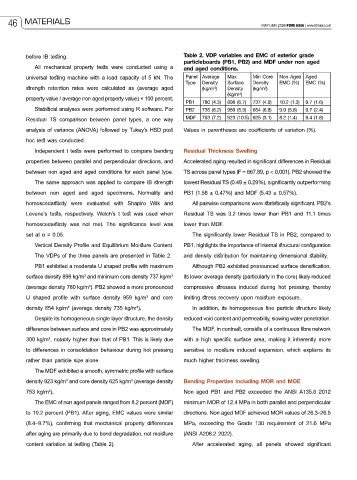
            The VDPs of the three panels are presented in Table 2.   and density distribution for maintaining dimensional stability.
            PB1 exhibited a moderate U shaped profile with maximum   Although PB2 exhibited pronounced surface densification,
          surface density 898 kg/m³ and minimum core density 737 kg/m³   its lower average density (particularly in the core) likely reduced

          (average density 780 kg/m³). PB2 showed a more pronounced   compressive  stresses  induced  during  hot  pressing,  thereby
          U  shaped  profile  with  surface  density  959  kg/m³  and  core   limiting stress recovery upon moisture exposure.
          density 654 kg/m³ (average density 735 kg/m³).        In  addition,  its  homogeneous  fine  particle  structure  likely
            Despite its homogeneous single layer structure, the density   reduced void content and permeability, slowing water penetration.
          difference between surface and core in PB2 was approximately   The MDF, in contrast, consists of a continuous fibre network
          300 kg/m³, notably higher than that of PB1. This is likely due   with  a  high  specific  surface  area,  making  it  inherently  more
          to differences in consolidation behaviour during hot pressing   sensitive  to  moisture  induced  expansion,  which  explains  its
          rather than particle size alone.                   much higher thickness swelling.
            The MDF exhibited a smooth, symmetric profile with surface

          density 923 kg/m³ and core density 625 kg/m³ (average density   Bending Properties Including MOR and MOE
          753 kg/m³).                                        Non  aged PB1  and  PB2  exceeded the  ANSI  A135.6  2012
            The EMC of non aged panels ranged from 8.2 percent (MDF)   minimum MOR of 12.4 MPa in both parallel and perpendicular
          to 10.2 percent (PB1). After aging, EMC values were similar   directions. Non aged MDF achieved MOR values of 26.3–26.5
          (8.4–9.7%),  confirming  that  mechanical  property  differences   MPa, exceeding the Grade 130 requirement of 21.6 MPa
          after aging are primarily due to bond degradation, not moisture   (ANSI A208.2 2022).
          content variation at testing (Table 2).               After  accelerated  aging,  all  panels  showed  significant

