


Page 46 - FDMAsia May/Jun 2026
P. 46
44   MATERIALS                                                                    MAY/JUN 2026 FDM ASIA | www.fdmasia.com


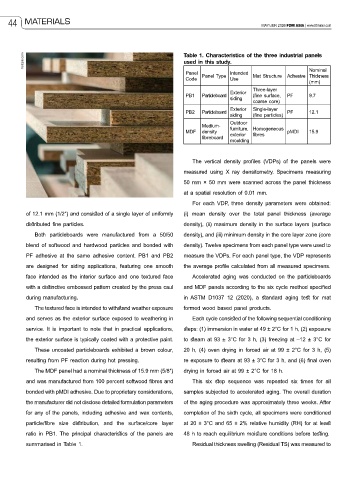
         holzply.com                                         Table 1. Characteristics of the three industrial panels
                                                             used in this study.
                                                                                                      Nominal
                                                             Panel   Panel Type  Intended   Mat Structure  Adhesive Thickness
                                                             Code           Use
                                                                                                      (mm)
                                                                                   Three-layer
                                                             PB1   Particleboard  Exterior   (fine surface,   PF  9.7
                                                                            siding  coarse core)
                                                             PB2   Particleboard  Exterior   Single-layer   PF  12.1
                                                                            siding  (fine particles)
                                                                            Outdoor
                                                                   Medium-  furniture,  Homogeneous
                                                             MDF   density   exterior   fibres  pMDI  15.9
                                                                   fibreboard
                                                                            moulding


                                                                The  vertical  density  profiles  (VDPs)  of  the  panels  were
                                                             measured using X ray densitometry. Specimens measuring
                                                             50  mm  ×  50  mm  were  scanned  across  the  panel  thickness
                                                             at a spatial resolution of 0.01 mm.
                                                                For  each  VDP,  three  density  parameters  were  obtained:

          of 12.1 mm (1/2″) and consisted of a single layer of uniformly   (i)  mean  density  over  the  total  panel  thickness  (average
          distributed fine particles.                        density),  (ii)  maximum  density  in  the  surface  layers  (surface
            Both  particleboards  were  manufactured  from  a  50/50   density), and (iii) minimum density in the core layer zone (core
          blend of softwood and hardwood particles and bonded with   density). Twelve specimens from each panel type were used to
          PF  adhesive  at  the  same  adhesive  content.  PB1  and  PB2   measure the VDPs. For each panel type, the VDP represents
          are designed for siding applications, featuring one smooth   the average profile calculated from all measured specimens.
          face intended as the interior surface and one textured face   Accelerated aging was conducted on the particleboards

          with a distinctive embossed pattern created by the press caul   and MDF panels according to the six cycle method specified
          during manufacturing.                              in  ASTM  D1037  12  (2020),  a  standard  aging  test  for  mat
            The textured face is intended to withstand weather exposure   formed wood based panel products.
          and serves as the exterior surface exposed to weathering in   Each cycle consisted of the following sequential conditioning
          service.  It  is  important  to  note  that  in  practical  applications,   steps: (1) immersion in water at 49 ± 2°C for 1 h, (2) exposure
          the exterior surface is typically coated with a protective paint.   to  steam  at  93  ±  3°C  for  3  h,  (3)  freezing  at  –12  ±  3°C  for
            These uncoated particleboards exhibited a brown colour,   20  h,  (4)  oven  drying  in  forced  air  at  99  ±  2°C  for  3  h,  (5)
          resulting from PF reaction during hot pressing.    re exposure to steam at 93 ± 3°C for 3 h, and (6) final oven
            The MDF panel had a nominal thickness of 15.9 mm (5/8″)   drying in forced air at 99 ± 2°C for 18 h.

          and was manufactured from 100 percent softwood fibres and   This  six  step  sequence  was  repeated  six  times  for  all
          bonded with pMDI adhesive. Due to proprietary considerations,   samples subjected to accelerated aging. The overall duration
          the manufacturer did not disclose detailed formulation parameters   of the aging procedure was approximately three weeks. After
          for  any  of  the  panels,  including  adhesive  and  wax  contents,   completion of the sixth cycle, all specimens were conditioned
          particle/fibre  size  distribution,  and  the  surface/core  layer   at 20 ± 3°C and 65 ± 2% relative humidity (RH) for at least
          ratio  in  PB1.  The  principal  characteristics  of  the  panels  are   48 h to reach equilibrium moisture conditions before testing.
          summarised in Table 1.                                Residual thickness swelling (Residual TS) was measured to

