


Page 35 - FDMAsia Mar/Apr 2026
P. 35
DESIGN       33
         www.fdmasia.com | FDM ASIA MAR/APR 2026


          over  material  quality,  and  post-installation  dissatisfaction   Residents of owned homes and independent houses prefer
          expressed by clients.                              handmade pieces for their permanence and value, whereas
            The challenges associated with modular furniture often   renters opt for modular due to convenience and lower cost.
          stem from its lower durability compared to handmade options.   Higher-income groups (₹15L+) show a strong preference
            Conversely, while handmade furniture is generally deemed   for modular (45%), reflecting modern lifestyles, while middle-
          more resilient, it faces challenges such as reliance on skilled   income consumers are evenly split, and lower-income groups

          artisans, financial limitations, and extended production durations.  show limited preference for either, largely due to affordability
            Yet,  experts  have  pinpointed  substantial  growth  potential   concerns.
          in both types of furniture.                           Awareness  of  modular  brands  like  IKEA  is  high  (91%),
            There was a clear understanding that improving quality and   but unfamiliarity is more common among those earning below
          design  standardisation,  along  with  incorporating  customised   ₹5L annually. Key purchase drivers include cost-effectiveness
          solutions,  could  boost  the  reliability  and  attractiveness  of   (71%), durability (69%), and customisation (60%).
          modular furniture.                                    Most consumers buy from local carpenters or showrooms,
            At  the  same  time,  handmade  furniture  provides  distinct   though 48 percent have purchased online.
          value  by  supporting  local  artisanship,  offering  high  levels  of   In modular furniture, design (84%), value for money (71%),

          customisation, and aligning with luxury design trends.   and ease of assembly (61%) are prioritised, though challenges
            Survey  findings  reveal  that  64.9  percent  of  professionals   include limited customisation (43%), poor durability (25%), and
          predict that, over the next decade, the industry will gravitate   difficulty in assembly (21%).
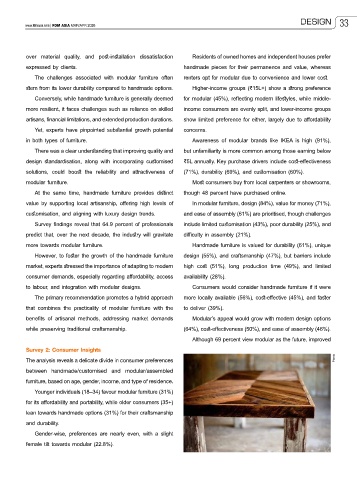
          more towards modular furniture.                       Handmade furniture is valued for durability (61%), unique
            However,  to  foster  the  growth  of  the  handmade  furniture   design (55%), and craftsmanship (47%), but barriers include
          market, experts stressed the importance of adapting to modern   high  cost  (51%),  long  production  time  (49%),  and  limited
          consumer demands, especially regarding affordability, access   availability (28%).

          to labour, and integration with modular designs.      Consumers would consider handmade furniture if it were
            The primary recommendation promotes a hybrid approach   more locally available (56%), cost-effective (45%), and faster
          that combines the practicality of modular furniture with  the   to deliver (39%).
          benefits  of  artisanal  methods,  addressing  market  demands   Modular’s appeal would grow with modern design options
          while preserving traditional craftsmanship.        (64%), cost-effectiveness (50%), and ease of assembly (46%).
                                                                Although 69 percent view modular as the future, improved
          Survey 2: Consumer Insights
          The analysis reveals a delicate divide in consumer preferences                                      Pixnio
          between handmade/customised and modular/assembled

          furniture, based on age, gender, income, and type of residence.
            Younger individuals (18–34) favour modular furniture (31%)
          for its affordability and portability, while older consumers (35+)
          lean towards handmade options (31%) for their craftsmanship
          and durability.
            Gender-wise,  preferences  are  nearly  even,  with  a  slight
          female tilt towards modular (22.8%).

